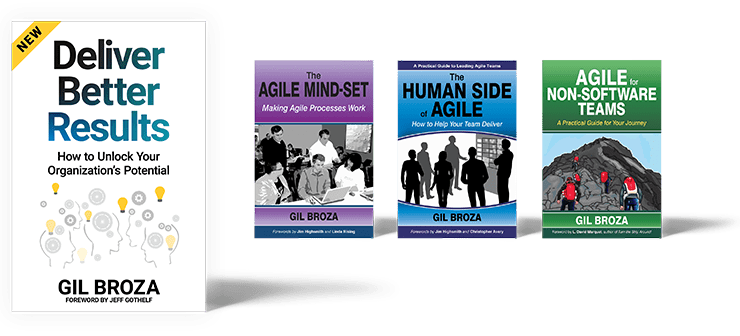
In just ten months, a 50-person software company transformed their struggling Product Development into one that delivered great results. I’m Gil Broza, and this is the story of how they did that by following SQUARE, an efficient roadmap I’ve detailed in my book Deliver Better Results. SQUARE guides companies through gradually improving how well their value delivery system helps them achieve their objectives.
Context
In 2019, a leading corporation acquired this company but kept it as a mostly independent division. In early 2021, new senior managers rolled out Scrum to increase customer focus, collaboration, and speed of delivery. But improvement was slow and inconsistent, and the teams — who made up 80% of the company — didn’t like the process. That’s when they called on 3P Vantage, and I started working with them in December. My assessment confirmed that the system of value delivery was at fitness Level 1: while it had some successes, it was unable to contribute adequately to achieving company objectives. We would continue their shift to an agile model, as it was appropriate for their goals and context.
Moving from Level 1 to Level 2
Preparations continued in January 2022, when everyone took my Pragmatic Scrum course to build a shared mental model of agility and its related behaviours. I then facilitated several meetings for designing the way of working, first with all the managers, then with the team leads as well. Management, in consultation with the staff, shifted some product roles, adjusted the Scrum teams’ membership based on product needs and technical expertise, and upgraded the team lead role. They also canceled an inefficient weekly cross-team meeting, replacing it with offline updates.
The company had many initiatives in progress, each assigned to a separate person, including many contractors. As a result, teams weren’t really teams. Calling management’s attention to the consequences of this dynamic was enough to get action. The head of product captured every initiative in a roadmapping tool and then narrowed the list down. Later, he’d narrow it down even more.
Moving from Level 2 to Level 3
By March, the value delivery system’s fitness was at Level 2: it contributed to achieving company objectives, but neither effectively nor efficiently enough. The progress made in just a few weeks was palpable, and all the leads felt positive about it.
The roadmap was now the single source of truth. The leads stabilized the system, specifically by reducing WIP and cleaning up backlogs, and streamlined status tracking. In collaborative workshops, folks wrote one-page charters for each of the top 10 roadmap items, which increased clarity and alignment and facilitated the sequencing of the work involved in each. Senior management was laying the groundwork for some role shifts to address inconsistencies in high-level decision-making. When I pointed out to them that teams were quietly skeptical that the changes were for real, the leadership committed to be more proactive and transparent, and to be explicit about the behaviours they expected from the teams.
The company was used to putting out a major release every six months, which was not unreasonable in their field. In April, they were finalizing the mid-year release and planning the next one. They didn’t reduce the six-month cadence yet, but did change their approach to commitments and to intermediate releases: every two months there’d be a feature release (as opposed to just a bug-fix one), and it’d be a “train” release: any feature that wasn’t ready would wait for the next release. Ownership of the roadmap shifted from the founder to the product management team, and the roadmap started including sequenced outcomes with suggested, rather than binding, dates. Product Development collaborated weekly with Marketing to minimize surprises and maximize Marketing’s lead time. Teams were reducing their WIP, which helped them finish more sprints as planned.
Level 3
By mid-year, the system of value delivery made it to fitness Level 3. That’s where results are satisfactory, but fully dependent on a few people who make all the high-impact decisions. To graduate out of Level 3, SQUARE suggests three strategies, two of which sit firmly on the human side of work (rather than the process side of it).
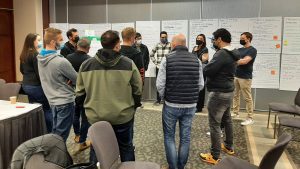 Team touchpoints were becoming more collaborative and worth having. The company took everyone to a three-day off-site for strategy discussions, team building, and all-voices-heard “What should we do next” discussions. There was a noticeable but still small increase in people’s perceived safety and their collaboration, two matters we had prematurely tried to improve at Level 2.
Reassessing fitness in August, we determined that the system was at the top end of Level 3. Product reviewed the roadmap frequently, and had streamlined a process for regularly bringing requirements, feedback, and internal improvements into it. There were earnest discussions about reducing release lengths and moving to frequent deployments. Team members, who had previously sat silent in sprint planning meetings while the team leader and PO spoke, were now participating actively. There was more collaboration between developers and members of the content team. The strategies used in Levels 1 and 2 were becoming more habitual and more effective: leaders were constantly keeping a viable limit on roadmap items (which was hard for them!), breaking work down better, and ensuring decision-ownership clarity.
Despite all the progress, many issues remained. The top issues were dependencies between teams, frequent breakage due to code changes, scope management and planning, and consistency of messaging around release dates. Nevertheless, when the owning corporation ran their ecosystem-wide engagement survey in October, this division was the only one that came out all green. Every score was between 85% and 100%, with the highest-scoring aspects being belief in the mission, alignment, team, safety, equality, and autonomy.
The company was pursuing a major revamp of the product’s UI in the second half of the year. Any other year, they’d have executed it as a Waterfall project. Instead, they demonstrated considerable agility, creating a task team that evolved the design and the implementation, testing and iterating continuously. Facing another significant initiative a few months later, they had an easier time adapting their team structure and processes.
Level 4
The last I worked with them was November 2022, as value delivery’s fitness reached Level 4: effective and efficient, but slower to achieve major outcomes than it needs to be. From that point, they’d continue on their own.
My total involvement up to that point included only charting the path, three course sessions, facilitating an Open Space at the off-site, and 30 half-days of online coaching and advisory spread across the year. I attribute much of their success to management’s consistent and aligned commitment to creating agility, and their speed of getting there to following SQUARE’s roadmap instead of trying big-bang transformation.